← ProtoBridge
Electronic ceramics · blank-to-tolerance work

We don't sinter the ceramic. We make it fit.

Technical ceramics are bought as blanks and sold as tolerances. Sintering a substrate and brazing copper onto it belong to the ceramics plants. Cutting it to a non-standard outline, grinding it to thickness, holding the warp, and proving it measured — that is the end of the chain where small batches stop.

Send a drawing How the seven steps run
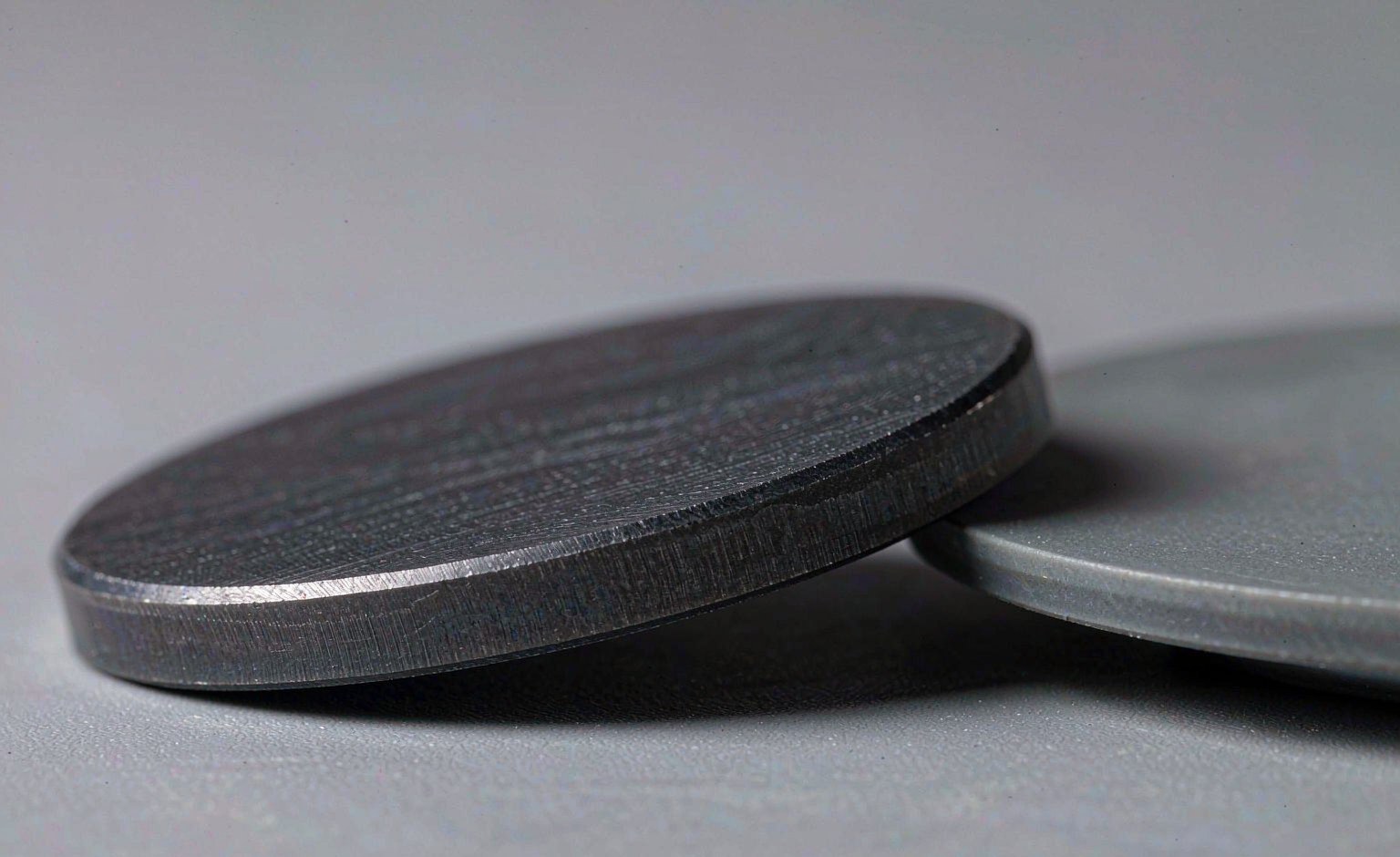
Ground chamfer and fine diamond grinding marks on the edge of a sintered silicon nitride plate

Where our part of the chain starts and stops.

A ceramics supplier that will not draw this line is telling you it does everything. Nobody does everything.

What we take on

  • Incoming blanks, machined to drawing. You or your ceramics plant supply the sintered blank; we hold the finished dimension.
  • Green machining before sintering. Shapes cut while the material is still soft, so a small run does not carry a die cost.
  • Post-sinter diamond grinding and lapping to thickness, parallelism and flatness.
  • Laser or ultrasonic cutting to outlines the blank was not pressed in.
  • Drilling, chamfering and edge break — where thin substrate chips, this is the step that decides yield.
  • Measurement and paperwork: thickness, TTV, warp, Ra, edge chip count, dimensions.

What we do not take on

  • We do not sinter. No tape casting, no pressureless or gas-pressure furnace, no sintering-aid formulation.
  • We do not braze copper. AMB, DBC and DPC are not processes this shop runs, and we will not quote them as if they were.
  • We do not sell substrate as a catalogue part with a stock list. Every substrate we touch is somebody's drawing.
  • We do not promise a Cpk figure on a 30-piece lot. That number would be arithmetic, not capability.

Five ceramics, and what each one is actually for.

The mistake in this category is picking the material with the best single number. Every grade here wins one column and loses another.

MaterialWhat we machineWhy it gets pickedWhat it gives up
Alumina
Al₂O₃ 96% / 99.5%
Discs, rings, washers, standoffs, insulators, wear plates Cheapest per part, good dielectric strength, available in every thickness 20–30 W/(m·K) and fracture toughness around 3.5–4.0 MPa·m1/2 — it cracks under fast thermal cycling
Zirconia
3Y-TZP
Plungers, sleeves, blades, wear faces, small precision parts Highest strength and toughness of the common grades; takes a fine surface finish Low thermal conductivity, and it degrades in hot steam — not a furnace material
Silicon nitride
Si₃N₄
Substrate blanks, plates, rollers, guide parts, wear rings Toughness 6–8 MPa·m1/2 with 600–900 MPa bending strength — survives thermal shock that destroys alumina Grinding is slow and diamond-bound; the material is expensive per blank
Aluminium nitride
AlN
Heat-spreader plates, insulating washers, thin discs 170–220 W/(m·K) — the highest conductivity of the electrically insulating ceramics Brittle: toughness only 2.5–3.5 MPa·m1/2. It is a heat path, not a structural part
Silicon carbide
SSiC / RBSiC
Seal rings, nozzles, liners, pump parts Hardness and wear resistance at temperature; chemically stable Not an electrical insulator in the grades we machine — do not specify it for isolation
Machinable glass-ceramic
Macor-type
Prototype fixtures, feedthrough bodies, lab parts, single pieces Cut and drilled with ordinary carbide tooling — no diamond, no green machining Modest strength; a prototyping material, not a production one
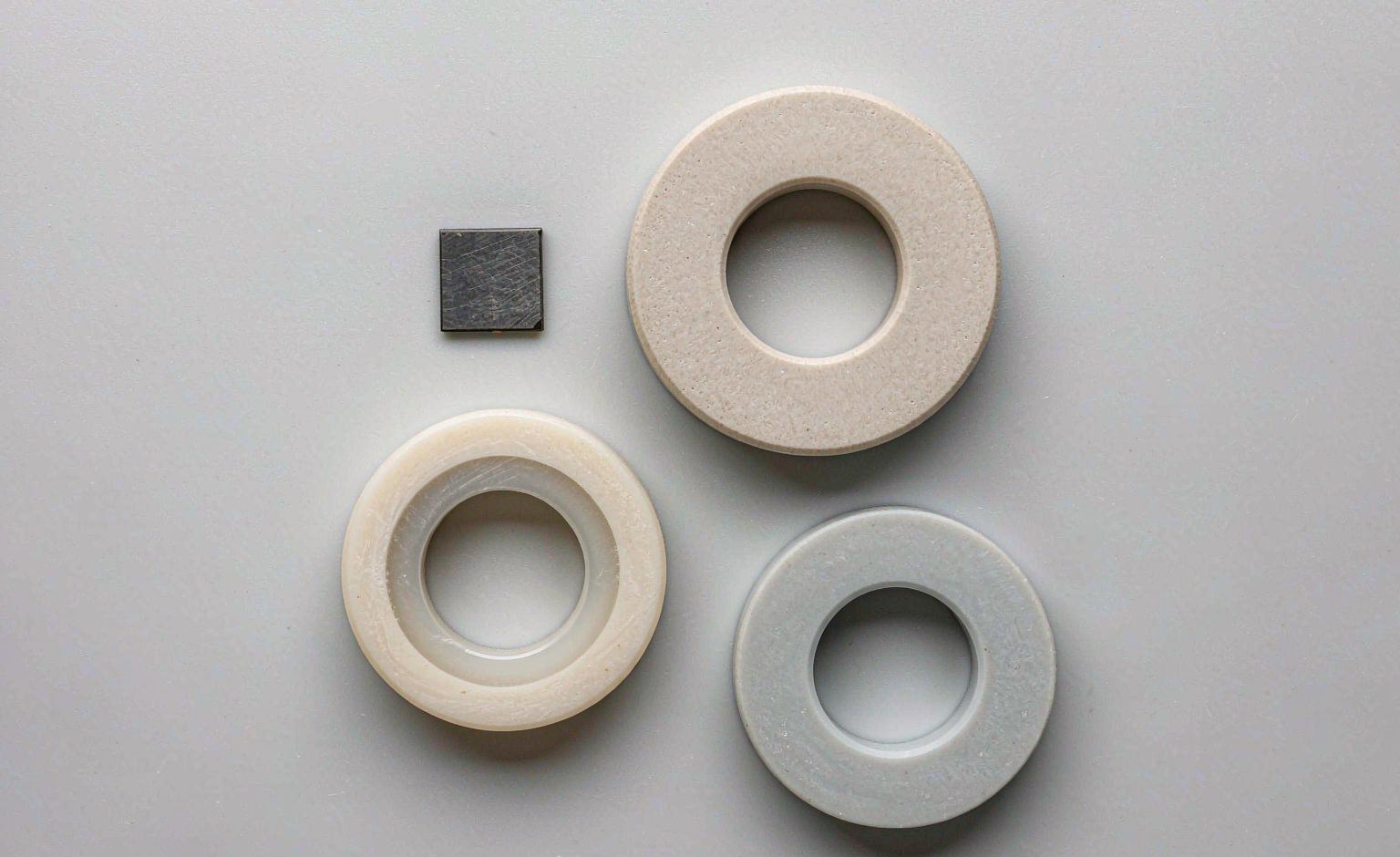
Four sintered ceramics side by side: a thin graphite-grey silicon nitride plate, an ivory alumina ring, a warm zirconia ring and a pale grey aluminium nitride disc
If the part has to survive a thermal cycle, the choice is not a matter of preference. At −40 to +175 °C with thick copper and high current, alumina cracks and aluminium nitride cracks faster. The grade comparison, with the numbers and the boundaries, is on substrate grades.

Seven steps after the furnace.

A sintered blank is not a part. It becomes one in this order — and the step that usually goes wrong is not the one people watch.

01

Lapping & grinding — in-house

Thickness, parallelism and flatness. A sintered substrate arrives with roughly 20% shrinkage already baked in, so the blank is near-size and the grinder only removes the difference. This is the slow, expensive, diamond-bound stage.

02

Polishing — in-house

Surface finish for bonding or for sealing faces. Ra target comes from your drawing: Ra RANGE WE HOLD.

03

Cutting — in-house / laser-outsourced

Non-standard outlines, windows and slots. Thin substrate is where chipping starts, so the cut sequence matters more than the cut speed. CUT METHOD AND KERF WIDTH

04

Cleaning — in-house

Grinding media and diamond residue have to come off before inspection, or every measurement is measuring the dirt. Note for fluoride users: silicon nitride is attacked by hydrofluoric acid — it is the one chemical this material does not tolerate.

05

Drying — in-house

Controlled, because a wet porous ceramic measures wrong and packs worse.

06

Inspection — in-house, with one exception

Thickness, TTV, warp and dimensions are measured here and reported. Bond-layer inspection by scanning acoustic microscopy is outsourced — we do not own a SAM and we will not pretend a visual check replaces one.

07

Packing — in-house

Edge-protected, plate-separated, because a chipped corner is a scrapped part and freight is not gentle.

The step that decides the batch is step 01 and step 02 — not the cutting everyone photographs. Grinding and polishing parameters drift, and a drift shows up as a warp or a thickness spread across the lot, not as one bad part you can see. Which is why the useful question to ask any supplier in this category is not "what machine do you have" but "how do you know the lot is consistent".

Who this work comes from.

Small batches, one drawing at a time. The volume end of this industry does its post-processing in-house, and we are not built to compete with it.

01 / Laboratories

University and institute labs

One piece, one drawing, one deadline. Test rigs, insulating parts, sample holders, Macor-type prototypes before anyone commits to a mold. This is the batch no ceramics plant wants and no ordinary machine shop can hold.

02 / Equipment builders

Semiconductor and analytical equipment

Replacement plates, feedthrough bodies, chamber furniture and fixtures. Low volume, high mix, and a machine that is down until the part arrives — so the drawing matters more than the price.

03 / Product development

Hardware teams between prototype and production

A ceramic part that works in a demo and now has to work in 200 units. Too small for a ceramics plant to schedule, precise enough that a general machine shop will scrap it.

04 / Maintenance

Spares and form-fit replacements

A worn nozzle, a cracked guide, a seal ring with a supplier that no longer exists. Measure the original, model it, remake it in the right grade.

Where we are not the answer. AMB and DBC substrate makers and SiC module packagers run their own grinding lines, at a scale and a yield level this shop cannot match. We take their development lots and their overflow — not their production. A supplier who tells you otherwise has not seen their line.

Two pages deeper.

One is about choosing the grade. One is about holding the tolerance.

What this section is not.

It is not a claim to be a ceramics manufacturer. If your program needs a sintered substrate with copper already bonded, you need an AMB house, and we will say so in the first reply rather than quote around it.

What it is: a shop that takes the blank the ceramics plant made and turns it into the part your drawing describes, with the measurement to prove it. For a program between prototype and production, that is usually the piece that is missing.

The line this page is built around: we would rather lose the enquiry at the first email than lose the batch at the loading dock.

Send the blank spec and the drawing.

Material grade, blank size, finished thickness, tolerance and quantity. If the blank already exists, tell us who made it — it changes which grinding sequence we use.

Get a quote
Or email engineering@YOUR DOMAIN with the drawing attached.