← ProtoBridge
Shipping · duties · payment

What lands, who clears it, who pays.

Buyers who are new to importing from China get surprised by exactly two things: a duty bill they did not budget for, and a payment schedule they did not read. Both are cheaper to explain now than to argue about later.

The default: DAP

Delivered at Place. This is what we quote unless you ask otherwise.

IncotermWhat it means in practice
DAP — default We deliver to your address. You are the importer of record: you clear the import, and you pay duty and import tax directly to your customs broker or carrier. Your invoice from us is for the parts and freight only.
DDP — on request One landed price, duty and import formalities included, we act as importer. Simpler for you, and it costs a margin for the duty we carry and the risk we take on the classification. Ask for it if your finance team prefers a single number.
EXW / FCA Available if you have your own forwarder and a preferred broker. We hand over at the shop or at the forwarder's warehouse and you control everything after that.
Why DAP is the default. On small batches, the duty is often a small fraction of the order and the classification is specific to your product and your country. If we bundled an estimated duty into the price we would either overcharge you or quietly eat a loss — and the second one ends with a supplier who stops answering. DAP keeps the number honest. If you would rather not deal with it, ask for DDP and we will quote it.

The de minimis change, plainly

This is the single most common surprise for US buyers in the current rules, so it gets its own section.

Low-value shipments that used to enter without a formal customs entry no longer reliably do. In practice that means a shipment that would once have arrived like a parcel may now need a customs entry, an importer of record, and a duty payment. A first article sent by express is not automatically exempt because it is small or because it is a sample.

What that means for your order:

  • Budget for duty and any entry fee on every shipment, including small ones, until your broker tells you otherwise for your specific case.
  • Have an importer of record ready — normally your company, with a customs bond if your broker requires one.
  • Expect the carrier to ask you for a classification or a manufacturer address before release. We supply what they need.

What we prepare, every shipment: commercial invoice with a plain-language description of the goods, packing list with quantities and weights, the HS code suggestion we believe applies, country of origin, and the material composition where a tariff line depends on it. Final classification and duty rate remain your broker's call — we do not give customs advice for your jurisdiction.

Payment

Stated up front, because it is the second thing that causes a delay.

YOUR TERMS — replace with your real terms. The usual structure for a new small-batch customer: 50% on order, 50% before shipment; card accepted under $X; Net 30 available after three completed orders. Whatever you write here, the quote must match it exactly.
Currency
USD by default; EUR and GBP on request.
What the quote covers
Parts, finishing, packaging, and freight as a separate line. Never buried.
What it does not cover
Duty, import tax, customs brokerage and any entry fees — unless the quote says DDP.
Price validity
N DAYS from the quote date, because material prices move.
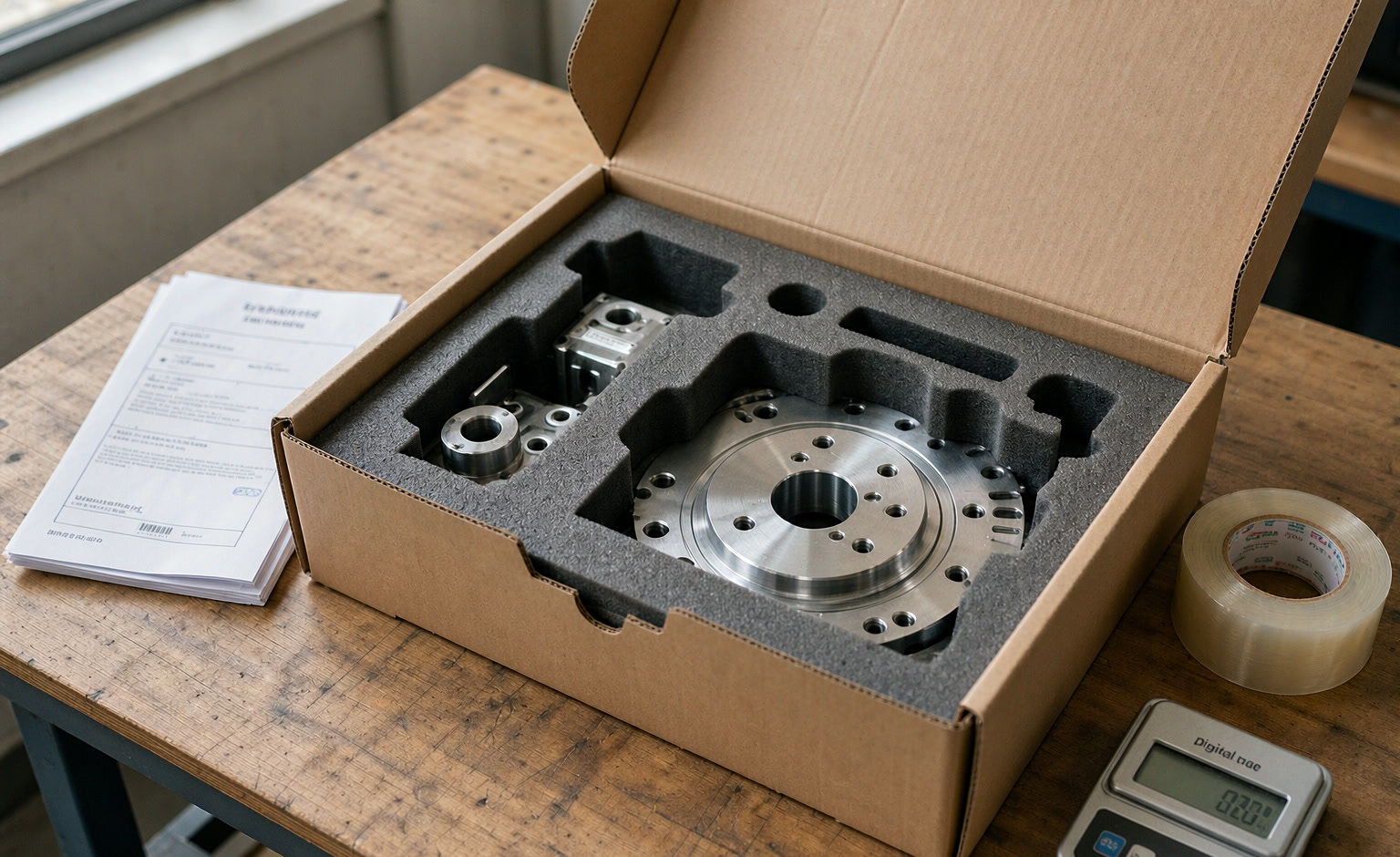
Foam insert with machined parts in a carton beside a packing list

Tooling, samples and freight

The three line items that decide whether a small order is worth running.

Tooling
Quoted as its own line, paid for by you, and owned by your program. It is not reused for another customer's parts. On request we store it for a stated period or ship it to you.
Sample fee
CHOOSE ONE: credited against the first production order / not credited, priced at cost. Say which, in the quote, before the sample is made. Ambiguity here is a bad way to start a relationship.
First articles
Express courier, because you need to hold the part. Tracked, with the inspection report in the same parcel and by email.
Batches
Air express for small and urgent, air freight for mid-weight, sea freight when the date allows. We quote the option you asked for and mention the cheaper one if it exists.
Packaging
Parts are packed to survive the trip, not to look good in a photograph: foam or cut inserts, individual bags for finishes that mark easily, desiccant where humidity matters, carton rated for the weight.
Lead time
Stated from drawing approval and first-article sign-off, not from the day you first emailed. Freight time is separate and is quoted separately.

Three questions worth asking any supplier

Including us. If the answers are vague, that is the answer.

01

Who is the importer of record?

If nobody will say it out loud, it defaults to you — including the bond and the entry fee.

02

What is the HS code, and who chose it?

A supplier who suggests a code and says "your broker decides" is being straight with you. One who guarantees a rate is not.

03

Is freight inside the price?

If it is, you cannot tell what you are paying for the part. Ask for it as a separate line.

Ask for a quote with both options.

Tell us the destination country and postcode, and whether you want DAP or DDP. You will get the parts price, the freight and the duty position as separate lines.

Request DAP and DDP pricing
Or put the whole request in the quote form — eight fields, no account.