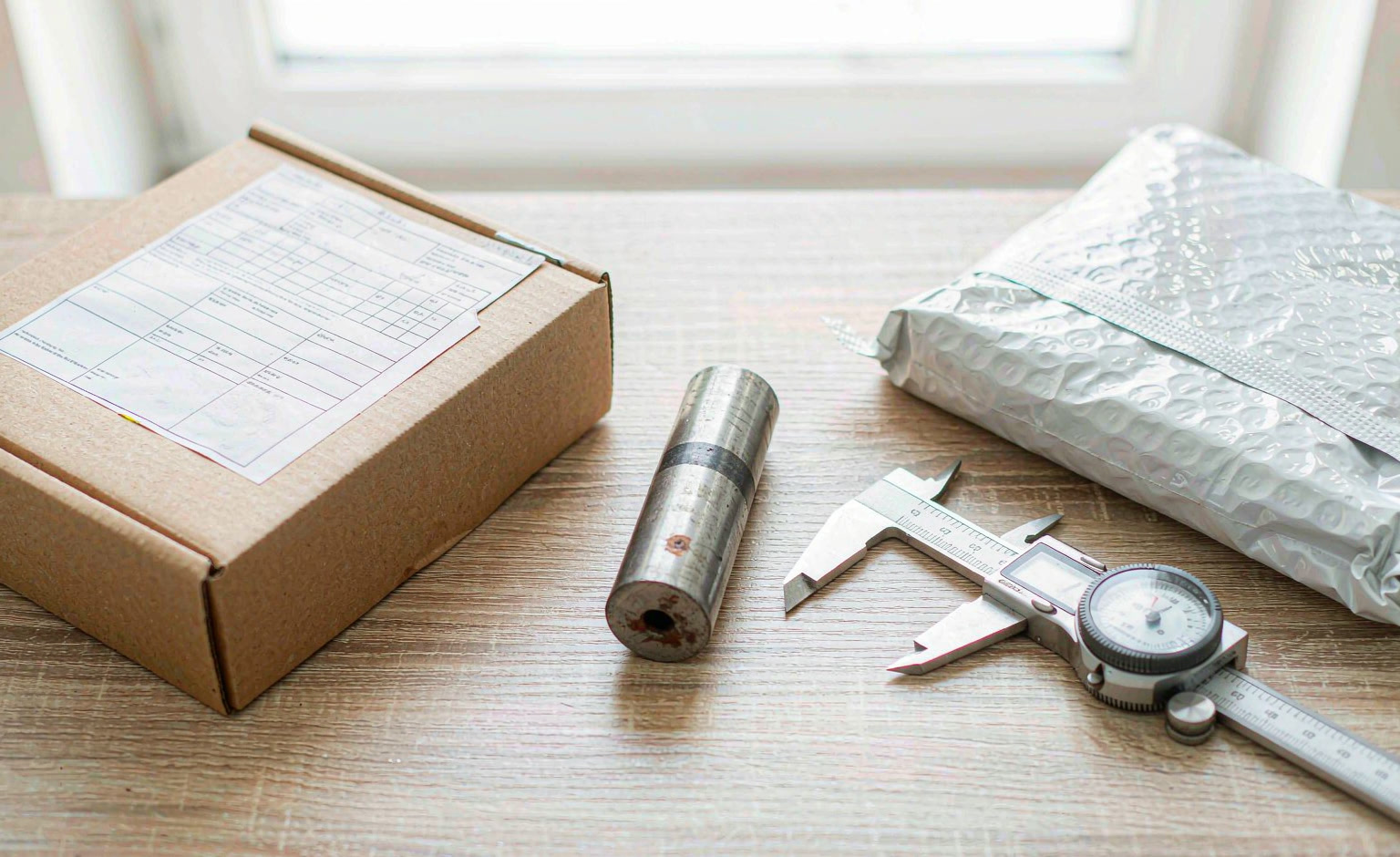
If the CAD does not exist — because the part came from a supplier who disappeared, or from a machine nobody supports anymore — a physical sample is a perfectly good starting point. It just has to survive the trip and clear customs without being held.
Four steps, in order. Step one is the only one that needs anything from you beyond an email.
Tell us what the part does, what it mates with, and the material if you know it. We reply with the address confirmation and any customs wording your carrier will ask for. Shipping without that email is how parcels sit in a warehouse for three weeks.
Photographs before anything is touched, dimensions recorded, condition noted. If the part arrives damaged we tell you and photograph that too, before we decide whether it is still usable.
The part is scanned or measured feature by feature, and rebuilt as a CAD model. You get the model or a drawing to check before anything is machined — this is the step where a wrong assumption about a thread or a radius gets caught for free.
The quote follows the model, not the other way round. Then one first article for your approval, then the batch. If the part turns out to be unmakable in the material you wanted, you hear it at this step instead of after a run.
Print this block and put it inside the parcel as well as on the outside. Print styles are set up for this page — use your browser's print command and you get the card without the navigation.
Copy this onto the customs declaration. It is ordinary practice for samples, and it is what the carrier expects to see.
Description: "Customer sample for inspection — no commercial value."
Declared value: a nominal value, stated honestly. Do not declare zero — a zero-value declaration gets questioned, and an under-declared parcel gets held or fined.
Include inside the parcel: the drawing if you have one, or a one-page note saying what the part does, what it mates with, the material if known, and the quantity you expect to order. That note is often more useful than the drawing.
| Situation | What to write |
|---|---|
| Broken or worn part | "Worn sample part for reverse engineering — no commercial value." Add a note on which surfaces are worn versus original. |
| Competitor's part you want matched | Same wording. No brand names in the description; the brand goes in your email, not on the customs form. |
| Several small parts | "Assorted sample parts for inspection — no commercial value." List each one on the packing list with a rough description. |
| Hazardous material | Tell us before shipping. Magnets, powders and some ceramics have carrier restrictions by air. |
People get attached to the only sample they have. Fair enough — here are the rules.
One line is enough: what the part does, roughly how many you need, and when you need them. We will reply with the address confirmation and anything your carrier will ask for.
Email us before shipping